

Prosthetic Services
Audubon Orthotics and Prosthetic Services Video
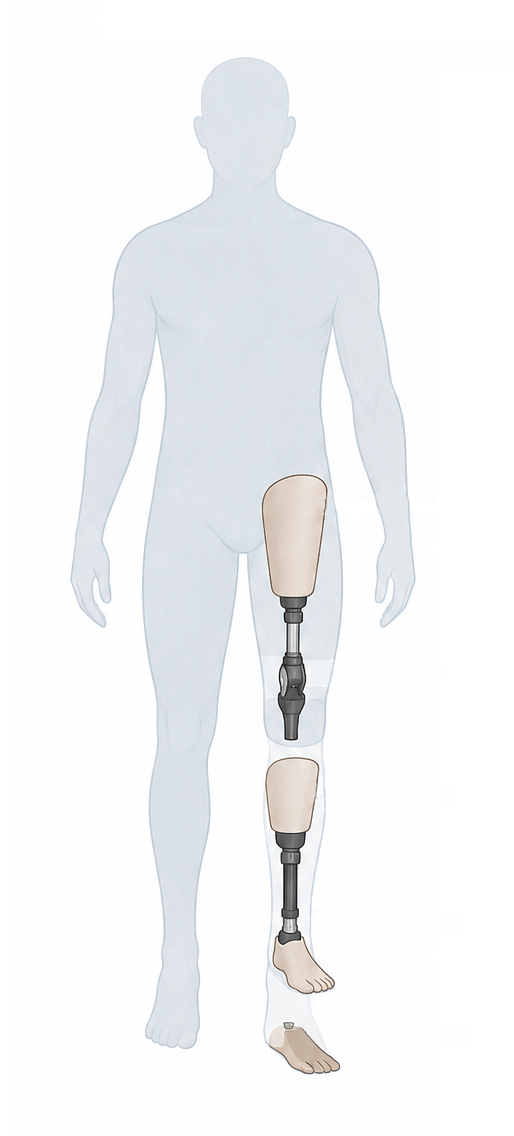
An above-knee, or transfemoral, prosthesis replaces the limb when the amputation is through the thigh. It includes a socket, a prosthetic knee, a pylon, and a foot. Because the biological knee is gone, the prosthetic knee must be stable in stance and able to flex for sitting and swing. Know More
A below-knee, or transtibial, prosthesis is used when the amputation is below the knee and the natural knee joint is preserved. Typical parts include a custom socket, liner, suspension, pylon, and prosthetic foot. The remaining thigh and knee still power and control walking. Know More
A knee-disarticulation prosthesis is used when the amputation is through the knee joint and the thigh bone is left intact. The residual limb is often long and may tolerate some end-bearing. The prosthetic knee is attached below the residual limb, so the knee axis sits lower than on a transfemoral limb and can look bulkier when sitting. Know More
A Syme’s amputation is an ankle disarticulation that typically preserves the heel pad so the residual limb can take some end weight. The prosthesis must fit a bulbous distal end. Designs include a closed, stovepipe-style socket that uses the contour for suspension, or a windowed socket that is closed with straps for a slimmer ankle line. A prosthetic foot is attached under the residual heel. Know More
A partial-foot prosthesis or filler replaces toes or a portion of the foot after ray resection, transmetatarsal, Lisfranc, Chopart, or similar amputations. It may be a toe filler in a shoe, a custom insert with a carbon plate, a forefoot prosthesis, or an ankle-foot orthosis with a filler, depending on how much of the foot remains and how the ankle functions. Know More
A preparatory, or temporary, prosthesis is a functional limb used after the surgical wound has healed enough and residual-limb swelling has begun to settle, often around 6 to 10 weeks, longer if healing is slow. Sockets and some components are expected to change. It is not the final cosmetic or definitive limb. Know More
The socket is the custom-molded interface between the residual limb and the rest of the prosthesis. An anatomical socket is shaped from a cast or scan of the patient’s limb so that load is shared over appropriate areas and bony prominences are relieved. Liners, socks, and suspension (how the limb stays on) are part of the same system. Know More
A lower-extremity cosmetic prosthesis, or cosmetic cover, is a shaped foam, plastic, or similar covering that gives the limb a more natural contour under clothing. It is built over the functional components. It is not a substitute for a well-fitted socket or a safe knee and foot. Know More
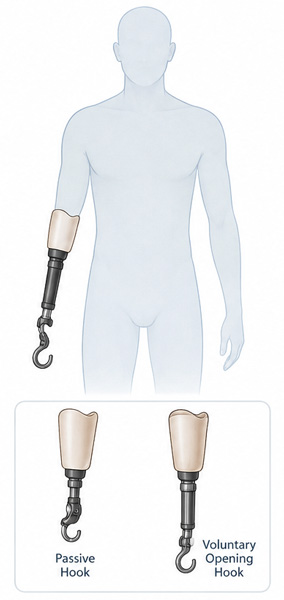
Upper-limb prosthetic systems are often grouped as passive or functional. A passive prosthesis looks like a hand or arm and can stabilize or push objects, but it does not actively grasp through cables or motors. A functional prosthesis uses body power, external power, or a hybrid of both so the terminal device (hook or hand) can open, close, or position. Know More
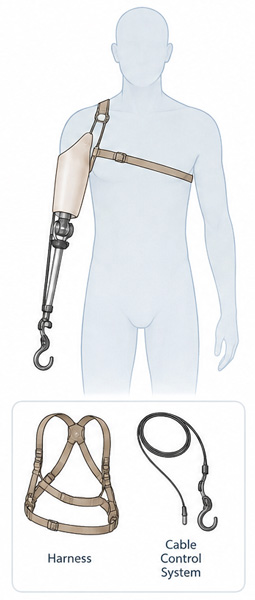
A body-powered arm prosthesis uses a harness and cable. Motion of the shoulders, upper arms, or opposite side tensions the cable and opens or closes a hook or hand, and in some designs operates the elbow. Voluntary-opening and voluntary-closing terminal devices are both used. These systems do not require batteries. Know More
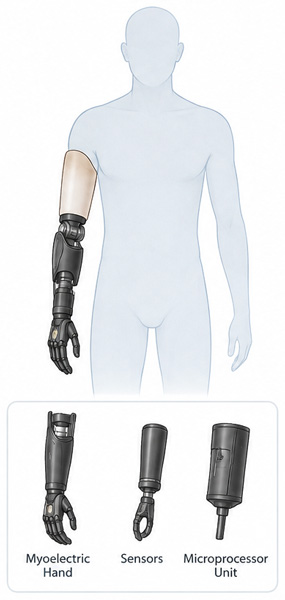
Microprocessor-controlled prosthetic systems use sensors and an onboard processor to adjust a joint or terminal device in real time. In the arm, this usually means myoelectric or similar powered hands, wrists, or elbows: muscle signals on the residual limb are read by electrodes and drive motors. In the leg, microprocessor knees (and some ankles) adjust resistance through stance and swing. The processor assists. It does not replace the user’s attention or training. Know More
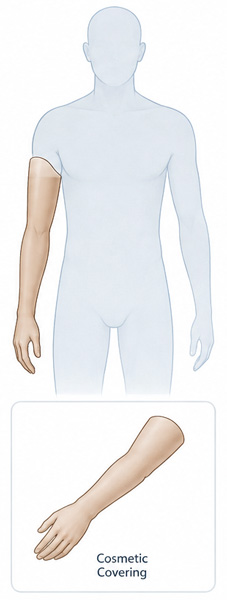
An upper-extremity cosmetic prosthesis is a restoration of the hand, partial hand, or arm in a skin-like material, often silicone, matched as closely as practical to the sound side. It may be entirely passive, or a cosmetic glove over a functional hand. Fine detail (nails, veins) is optional and is a separate fabrication choice. Know More
Click on a topic to see the detailed image
Audubon Orthotic & Prosthetic Services Patient Testimonial - Josh Gavzy
If you wish to be advised on the most appropriate treatment, please call to schedule an appointment or click here to request an appointment online.
Personalized Solutions. Greater Mobility.
Don’t let mobility challenges hold you back. Our experienced team provides custom orthotic and prosthetic solutions designed around your needs, comfort, and goals.
